
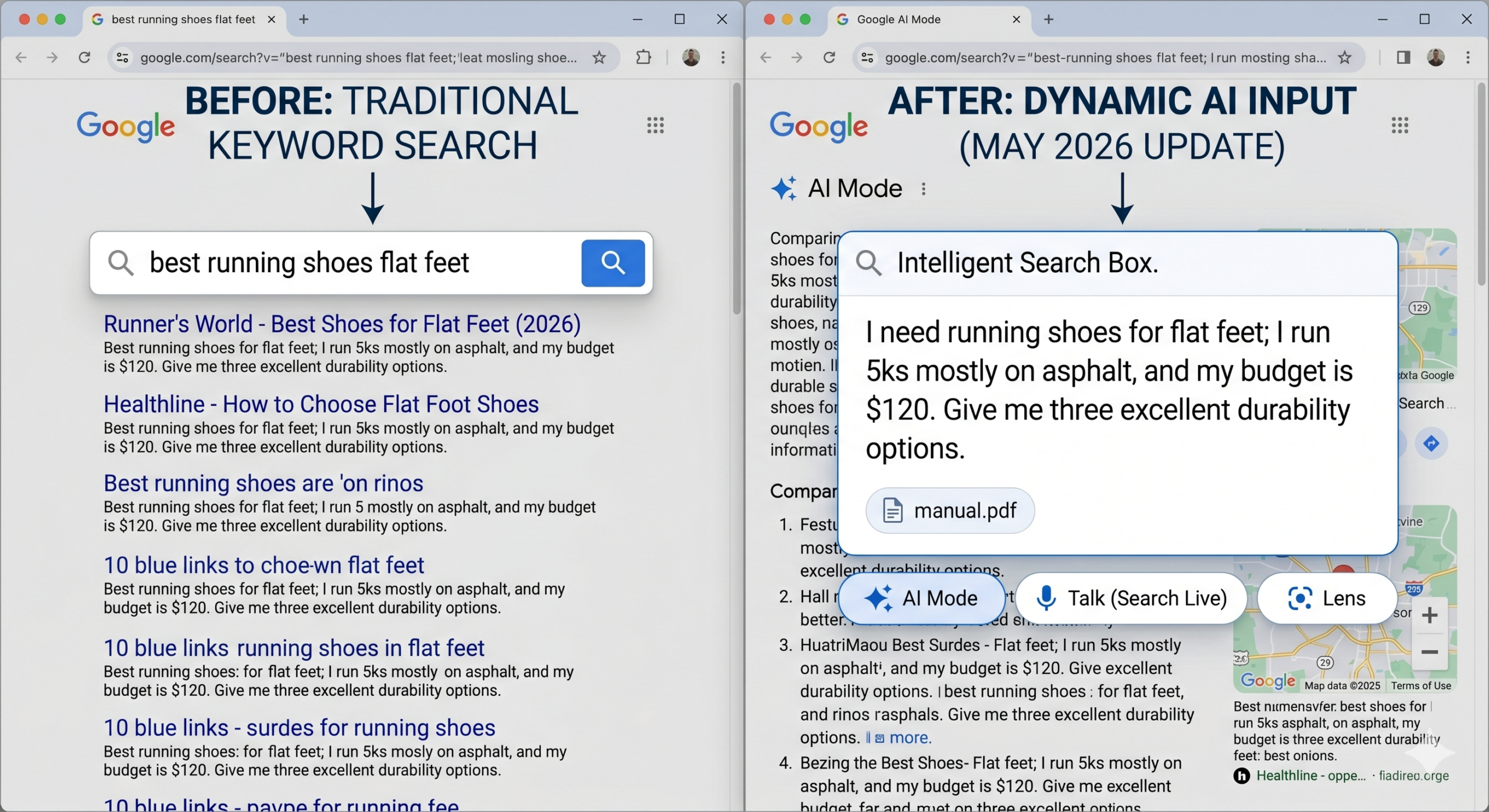
For over 25 years, the Google search bar has been a predictable, static white rectangle. We all learned to treat it like a digital filing cabinet, training ourselves to type in awkward, robotic keyword fragments like "best hiking boots waterproof" to find what we wanted.
But following the massive Google I/O 2026 search updates, that classic white box is officially history.
Google has rolled out the Google Intelligent Search Box– a total redesign that turns the search bar into a flexible, conversational workspace powered by Gemini 3.5 Flash search. This update fundamentally changes how people find information, and it has triggered a massive debate over the future of SEO and AI search.
If you are a business owner or a creator wondering if your organic traffic is about to drop to zero, take a deep breath. SEO isn’t dead- but the way your audience searches is changing completely. Let’s break down exactly what this means in plain English, with zero confusing tech jargon.
- What is the Google Intelligent Search Box and how do you use it?
- How does Google’s new AI search box impact SEO website traffic?
- How to optimize your website for Google Generative Engine Optimization (GEO)
- Debunking the Myths: Is organic SEO dead after the 2026 Google I/O updates?
- The New Rule of the Digital Road
What is the Google Intelligent Search Box and how do you use it?
Instead of forcing you to squeeze your thoughts into a tiny box, the new search box dynamically stretches downward as you type, giving you plenty of space to dump your thoughts in full, natural sentences.
Can you really drop files and Chrome tabs directly into Google Search?
Yes, and this is where it feels like magic. Because the interface now natively accepts multimodal search input, you don’t just have to type words. You can drop media and documents straight into the search line:
-
The PDF/File Drop: Imagine you are looking at a dense, 40-page appliance manual or a complex financial sheet. Instead of opening it and pressing
Ctrl + Fto look for keywords, you can drag the PDF file directly into the Google search bar and type: “Summarize the maintenance steps on page 12.” -
The Chrome Tab Drag: On a desktop browser, you can physically grab an open browser tab-like a competitor’s product page or a long-form recipe- and drop it right into the search bar. You can then ask: “What are some gluten-free alternatives to the ingredients listed on this page?”
The Engine Under the Hood
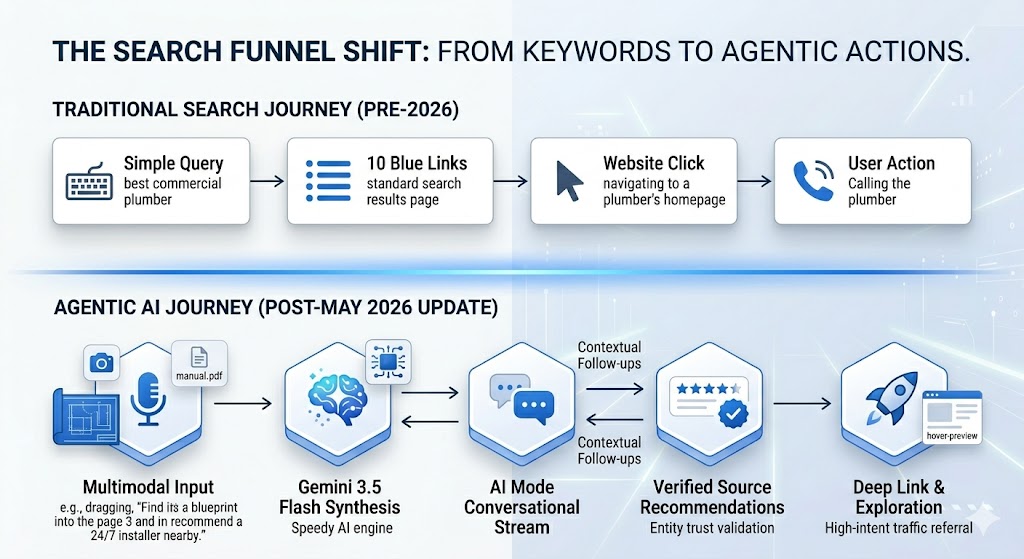
The second a file or a long sentence lands in the box, the system instantly switches into Google AI Mode. Driven by the hyper-fast Gemini 3.5 Flash, the search box drops the traditional list of links and opens a full, back-and-forth chat screen. It remembers the context of your files and past questions, letting you dive deeper without starting a new search from scratch.
How does Google’s new AI search box impact SEO website traffic?
The biggest phrase being thrown around industry boards right now is the rise of zero-click searches. This happens when a user types a basic, factual question and gets a complete, synthesized answer right inside the AI interface without ever needing to click a website link.
Example: If someone types, “What is an LSI keyword?”, Gemini 3.5 Flash will display a perfect definition right on the screen. Clicks to basic, informational blog posts that only define terms are going to drop significantly.
Will the Google Intelligent Search Box eliminate organic search results?
The short answer is no. While it changes the layout of the screen, it doesn’t kill organic search traffic- it filters it.
Think of it as a funnel shift. Casual, top-of-funnel browsers who just wanted a quick, free fact will stay on Google. But bottom-of-funnel searchers—people who are actively looking to buy a handcrafted terracotta lamp, hire a local commercial plumber, or solve a deeply specific problem- will still need to click through to deep web pages.
Because the AI does the heavy filtering upfront, the organic traffic that does reach your website will actually have much higher intent and be far more ready to convert.
How to optimize your website for Google Generative Engine Optimization (GEO)
To make sure your business doesn’t get left behind, you need to practice Generative Engine Optimization (GEO). Think of GEO as optimizing your website so it is easy for a smart assistant to read, trust, and recommend to others.
Here are three practical actions you can take right now:
Action 1: Create Answer-Shaped, Scannable Content
Stop writing long walls of fluffy text. When Google’s AI pulls information from the web to back up its answers, it uses a technique called “query fan-out,” scanning multiple subtopics at once. Organize your content using clear, direct question-and-answer headings (H2 and H3 tags) and structured bullet points. If a single paragraph on your site can stand alone as a brilliant answer to a specific question, the AI is highly likely to grab it and cite it.
Action 2: Use Advanced Structured Data Schema
Think of structured data schema as a universal translator code hidden in the background of your website. It tells the AI exactly what your data means. If you run an e-commerce shop, flawless product schema tells the AI your exact price, material, and shipping availability. This makes it incredibly easy for Google’s shopping agents to pull your product directly into a user’s conversational search stream.
Action 3: Build “Entity Trust” (The Digital PR Rule)
Google’s AI doesn’t just trust what you say about yourself on your own website. It builds trust by scanning the rest of the web to see if your business is legitimate. It looks for your brand name, products, and reviews on authoritative, third-party sites, business directories, and online discussions. The more external validation your brand has across the internet, the more comfortable the AI will be recommending your site as a trusted source.
Debunking the Myths: Is organic SEO dead after the 2026 Google I/O updates?
With any massive tech update comes a wave of panic and misinformation. Let’s set the record straight on the two biggest myths floating around online:
-
Myth #1: “Google is just stealing content and keeping all the traffic for itself.”
-
The Reality: Google knows that if it completely starves creators of traffic, creators will stop making high-quality content for the AI to learn from. To fix this, Google has built prominent, clickable source links, hover-previews directly over sentences, and a dedicated “Further Exploration” sidebar into AI Mode to actively drive interested users back to the original websites.
-
-
Myth #2: “You need to add special AI code or a new robots.txt file to be found.”
-
The Reality: There is no secret entry code or separate opt-in for AI search. Traditional, clean indexing eligibility remains the foundational gateway. If your technical SEO is solid and Google can crawl your site normally, you are automatically eligible to show up in the new Intelligent Search Box answers.
-
The New Rule of the Digital Road
At the end of the day, the Google AI search box update means search is transitioning from a mechanical word-matching game into a game of real trust and human context.
The businesses that thrive in this new era won’t be the ones trying to trick a computer algorithm with stuffed keywords. The winners will be the creators and brands who provide the absolute clearest, most honest, and best-structured answers for real human beings. Write for the human, structure it cleanly for the AI, and your traffic will take care of itself.
