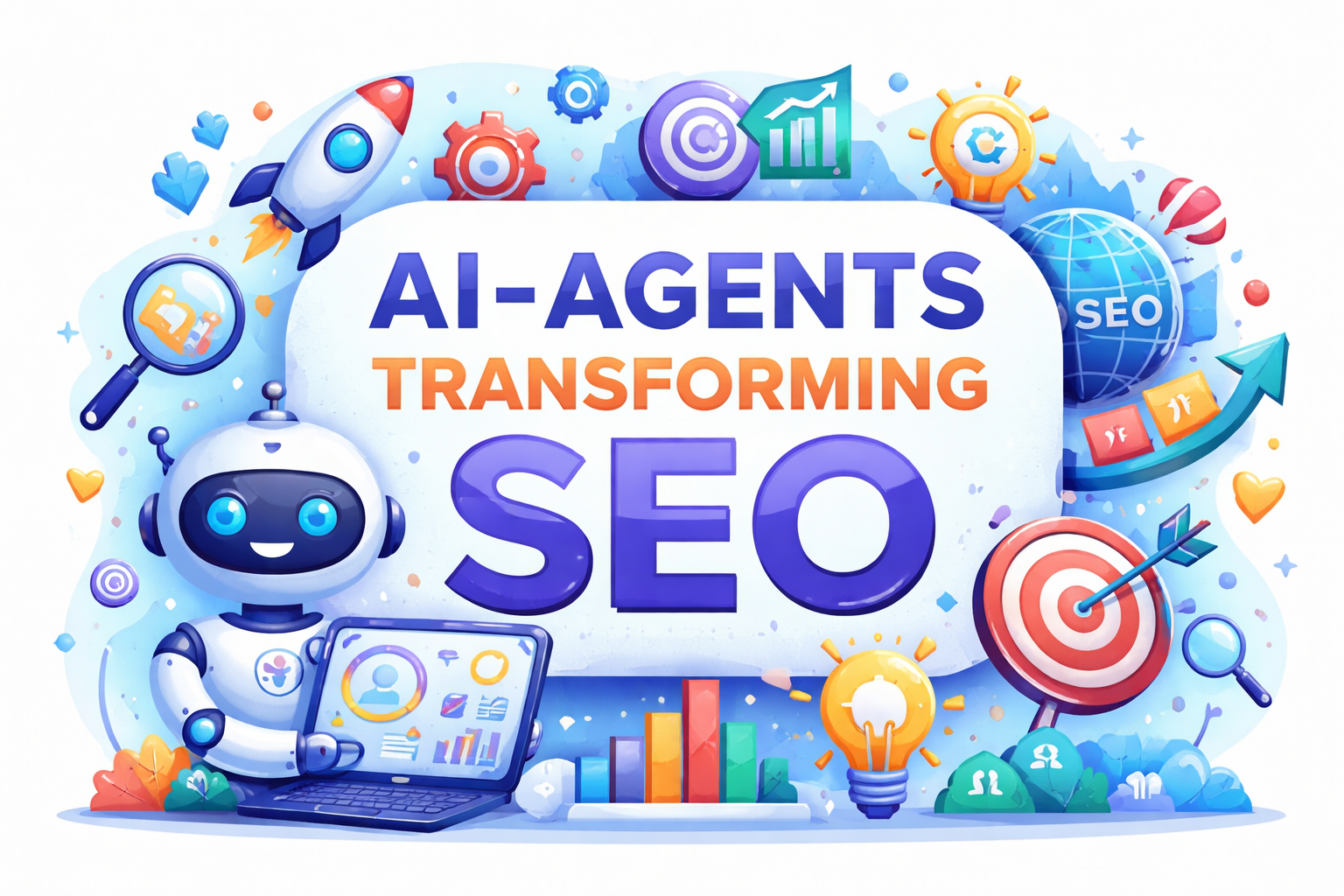
Technology has always shaped the evolution of seo. Seo began as keyword stuffing and has evolved to focus on semantic search, which looks at user intent. Seo has always adapted to more intelligent search engine algorithms and changes in user behaviour. The next major change to seo will have ai agents leading the way, as they are no longer just providing support to marketers, they are helping to create strategies, predict future results, and with seo improve in real-time.
Companies that understand how ai agents impact seo, digital marketing, and how web development will be ready to take advantage of opportunities over their competitors. In the future, search engines will be more than just manual and reactive to now they will be intelligent, automated and predictive in nature.
- Understanding AI Agents in Modern SEO
- The Evolution from Traditional SEO to AI-Driven Optimization
- AI Agents and the Transformation of Keyword Research
- Technical SEO and Intelligent Automation
- Predictive Analytics and Ranking Intelligence
- Search Intent and User-Centric Optimization
- The Role of AI in Link Building and Authority
- Preparing for the Future of AI SEO
- Conclusion
Understanding AI Agents in Modern SEO
Artificial intelligence agents are sophisticated software programs used to examine data and develop insights from their analysis of data via patterns and perform actions with little or no human interface (I.E., always performing the same functions). Unlike traditional seo providers (I.E., seo providers offer data analytics and reports on how websites are ranking) ai agents do more than just analyze data; ai agents can interpret search engine user behavior and can provide satisfactory recommendations for optimization and execute those optimizations automatically.
Ai agents rely on machine learning (ml), natural language processing (nlp) and advanced data modeling to continuously enhance their effectiveness in the seo space. Specifically, ai agents are constantly monitoring their ranking signals, monitoring their competitors’ activities and making adjustments to their strategies as a result of changes to seo algorithms. In other words, instead of reacting to a declining ranking after it has occurred, an ai agent anticipates changes in their performance and makes recommendations for proactive improvements.
The emergence of ai agents invokes a new era in digital marketing in which seo-related decisions will be more reliant upon artificial intelligence and techniques that automate tasks rather than relying on manual guessing.
The Evolution from Traditional SEO to AI-Driven Optimization
SEO was also once a manual process that required a lot of research, choosing keywords, and checking regularly. Returning to this will require marketers to use the most popular keywords for their site’s content and track the serp of their site for those keywords over time. But now that algorithms have become increasingly complicated (as detailed here), the way marketers do seo has changed completely.
SEO in 2026 will be less reliant on simply determining what keywords users are typing into the search engine and instead will leverage data analysis and machine learning-based tools to identify user’s intent and create a better user experience for visitors to their websites. This is a result of the evolution in how search engines determine relevance (by using numerous signals such as context, search intent, and user engagement), as well as how users interact (or do not interact) with the content on the marketing website.
Ai-enhanced SEO represents a shift from being focused exclusively on keywords to being focused on identifying how users are interacting with the content available online and how competitors have designed and developed their websites in relation to the changes in algorithms that impact search results.
AI Agents and the Transformation of Keyword Research
While keyword research is still an essential part of search engine optimization (SEO), AI (artificial intelligence) has dramatically changed this process. In the past, keyword research was all about searching for keywords based on their search volumes. Today, AI algorithms look at the semantic relationship between searches as well as examining how people communicate and recognizing developing trends in the search engine space.
With the increase of voice-activated search capabilities, and therefore, the growth of the use of AI to provide a suitable solution, you need to understand how your customers ask natural language questions in order to be able to create the appropriate keyword research strategies. AI is able to identify, through long_tail variations of keywords and context of searches, long-tail variations of keywords, which were impossible to find using traditional keyword research methods.
By taking advantage of this type of proactive analysis, companies will be able to find and target keywords before they become saturated with competition. This allows marketers to produce content that will gain traffic at the appropriate time by recognizing trends sooner. This prediction-inspiring approach is revolutionizing the planning and execution of SEO campaigns.
Technical SEO and Intelligent Automation
Historically speaking, technical SEO was complex and required a significant amount of time to run what were traditionally time-consuming tasks like monitoring crawl errors, optimizing the speed of the website, improving internal linking, and enhancing Structured Data, which would all require long-term maintenance.
Now, however, many of these technical SEO processes can be simplified by artificial intelligence (AI) agents. AI has the ability to monitor your website in real-time and can produce immediate results once it detects a technical issue by providing an immediate recommendation on how to correct it. Because of this, AI is also helping to ensure that minor problems do not grow into larger issues that could affect your overall ranking.
Search engines are also beginning to consider performance metrics such as Core Web Vitals and, as a result, AI-driven technical monitoring will be even more important as they continue to prioritize various performance metrics.
Predictive Analytics and Ranking Intelligence
Predictive analysis is one of the most helpful uses for SEO in conjunction with Artificial Intelligence. Businesses can use AI modeling to evaluate the potential performance of a specific piece of content by assessing relationships between trends currently in existence and past historical data along with comparisons to competitor behavior, patterns, and algorithm signals.
Marketers can identify forecasted drops in SERP rankings before they happen with predictive intelligence. If, for example, your competitor receives a significant number of backlinks to his site, or creates a significant quantity of high-quality content on any topic; the AI models would notify you of these activities so that you can take the appropriate corrective action before these trends reach your company and adversely impact your SEO performance. Thus, this allows many marketers to demonstrate their value to their companies by helping them operate in a proactive and strategically-minded manner rather than reactively.
Prediction analytics will constitute a paradigm shift from traditional SEO effectiveness metrics to intelligent forecast-based methodologies for measuring SEO potential.
Search Intent and User-Centric Optimization
Modern search engines now prioritize user intent over the presence of an exact keyword match. Artificial intelligence (AI) can analyze and determine what the intent of a user is (i.e., if they are looking for information, comparing different products, or are ready to make a purchase) and can relate the content to the intent of the user by determining the user’s usage patterns in relation to similar phrases. When a business creates content that is aligned with a user’s intent, such as providing information or product comparisons, they will see visitors clicking through to their site more often resulting in increased engagement and conversion rates. Therefore businesses will experience a significant benefit from providing valuable experiences through value delivery rather than creating web pages solely for the purpose of being found through a keyword search.
As AI technologies continue to change how search engines operate, the importance of optimizing web pages for intent will continue to grow as we approach the year 2026. To succeed at SEO in the year 2026, your primary focus should be to provide your users with meaningful and contextually appropriate user experiences and only secondarily offer visitors keyword content.
The Role of AI in Link Building and Authority
Building links continues to be one of the largest ranking factors; however, the way we create authority is changing due to artificial intelligence. AI systems can evaluate the importance or quality of an external site (through their domain name, the contextual alignment of the website to your business type, etc.) more accurately than using traditional manual outreach methods.
AI systems use their analysis of competitor backlink profiles to find potential new opportunities for partnerships or guest posting with high-ranking websites. This data-driven approach helps eliminate wasted time and allows for more efficient campaigns.
Rather than relying primarily on mass outreach efforts as in the past, marketers can now focus their efforts on creating strong, authentic relationships that are supported by intelligent analysis. This will lead to increased trustworthiness and provide both immediate and long-term stability in search engine optimization.
Preparing for the Future of AI SEO
To remain competitive in the world of AI-Enhanced search, businesses must engage in innovation; this includes investing in strong platforms for AI technology, developing a solid technical foundation and having a close working relationship with both their SEO specialists as well as their web developers.
Marketers must also create relevant, high-quality, authoritative content that matches what users want/expect to find from a search engine result. With each evolution of search algorithms, there will be on-going change and innovation required in order for marketing professionals to be successful.
Incorporating AI into your online advertising strategy has become essential for achieving success moving forward.
Conclusion
There has never been a time when the future of search engine optimization will have such a dramatic effect as it will with AI agents. Companies are utilizing AI to help them with research, strategy development, trend forecasting, automation of processes and content creation based on user intent.
When you combine the power of human imagination and insight along with AI, you have an incredible engine for businesses to help them improve their ranking, build relationships with future customers and become more visible throughout the years via their website(s).
We can expect that by the time we reach 2026, adaptive solutions will drive the future of SEO and those companies that strategically use AI agents will shape the future of SEO for all businesses.
